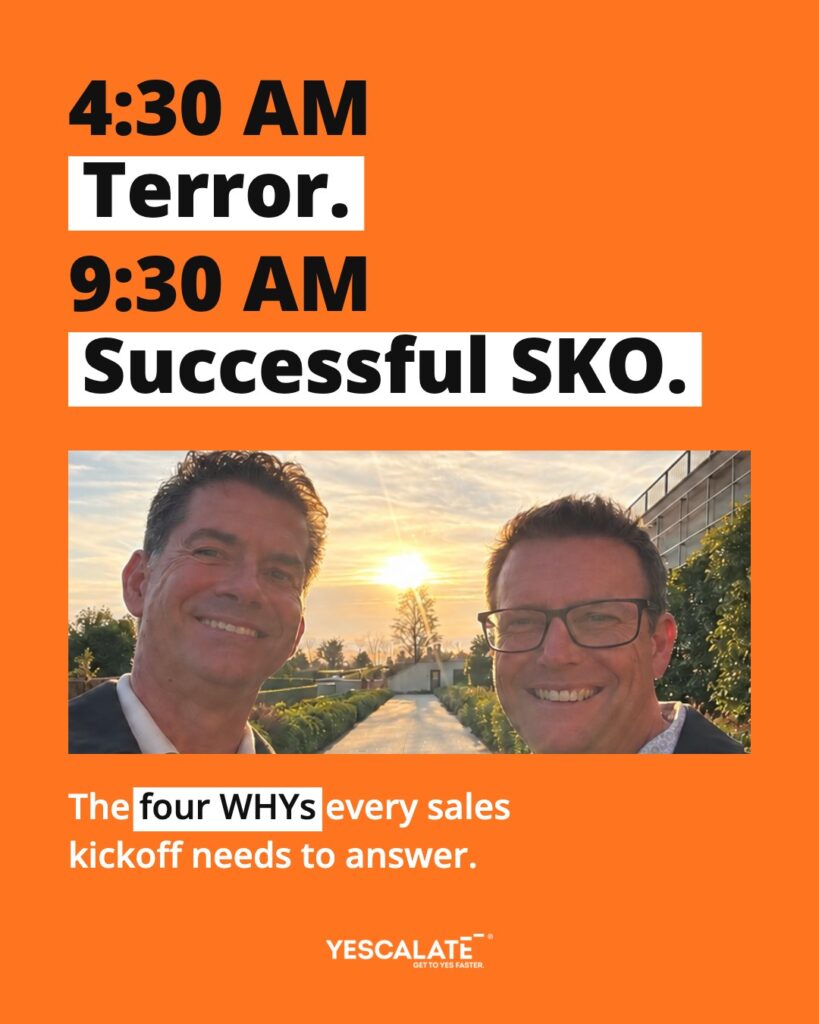
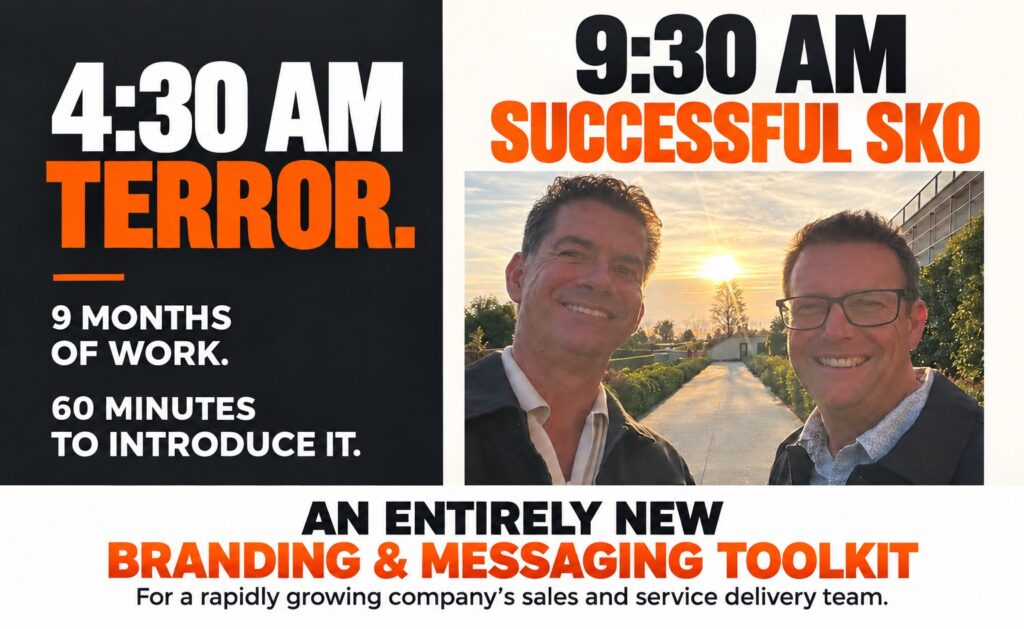
That’s me with my branding partner Ed. Be the Sun.
4:30 AM — Wednesday morning.
I woke up thinking, “I need to disappear.”
I had the whole client sales team scheduled for a virtual presentation at 8:30 AM, and I was previewing it in my mind.
“This is complete sh!#. I am sh!#.”
I briefly considered having someone call my client to tell them Dean Minuto had died. Then changing my name, moving to another country, and starting a new life.
Seriously.
5:30 AM — A path forward.
After two cups of coffee and rereading all my planning notes from the previous day:
“OK. I think I see a path forward.”
6:30 AM — Confidence returning.
“You know what? This is actually pretty good.”
7:15 AM — Starting Different®.
“Holy sh!#. This might be the best thing I’ve ever been involved with.”
8:30 AM — Time to roll it out.
The Sales Kickoff began.
Nine months of work.
60 minutes to introduce it.
And the feeling I carried into the meeting: that we had created something that would help the people on that call make more of a difference in their world. Not only the people on the call, but a whole generation of salespeople not yet hired by the company. Because we had created the template for more effective messaging.
What were we introducing?
An entirely new branding and messaging toolkit for a rapidly growing company’s sales and service delivery team.
My partner, Ed Horrocks, and I had spent more than NINE MONTHS developing the work with the CEO, leadership team, customers, salespeople, and marketing resources of a terrific client organization.
Nine months. Almost like giving birth.
And at 4:30 that morning, I was experiencing some serious labor pains.
A word about Ed.
I’ve been doing this work for more than 35 years, and Ed is one of the finest branding minds and purpose-driven thinkers I’ve ever met.
His ability to help organizations discover, articulate, and communicate what makes them different, and how they MAKE a difference, is extraordinary.
Our work combines his expertise in brand strategy and purpose with my experience in cognitive science, consultative selling, and sales performance.
And we share a fundamental belief:
The best work connects the company’s PURPOSE with the difference it makes for its customers.
We believe that work is best created WITH the client and THEIR clients.
What went into those nine months?
We began with the CEO and leadership team: the company’s origin story, beliefs, vision, and growth ambitions.
Then we listened to customers. What had influenced their buying decisions? What had they experienced? What did they value about working with the organization?
We studied competitors’ branding, positioning, and promises. Where did the language sound the same? Where could this organization explain a meaningful difference?
We interviewed top-performing salespeople to understand what they were doing, what worked, and why. We invited them into an early preview so their reactions, challenges, and ideas could help shape the work before the broader rollout.
We also inventoried capabilities, customer success stories, proof points, presentations, and marketing resources.
Then came the work of connecting all of it.
Nine months of listening, learning, questioning, challenging, creating, testing, refining, and occasionally Starting Different®.
What did we actually create?
The toolkit brought together several connected components.
1. A clearer purpose, position, and promise.
An explanation of what the organization stands for, what distinguishes it, and the difference it intends to make for customers.
The CEO’s beliefs needed to become something people throughout the organization could understand, believe in, and act upon.
2. A distinctive brand identity, narrative, and visual language.
A way to communicate the organization’s story through both words and design.
We wanted the external promise to reflect what the company’s people actually deliver, and to give sales and service delivery professionals a shared foundation for explaining that value.
3. A simple three-part messaging framework.
A structure that distilled substantial complexity into an explanation the team could remember, personalize, and use.
The framework gave people an organizing structure for the company’s story and the value behind it.
4. More useful presentation resources, customer stories, and proof.
We worked with the internal team to make capabilities, examples, presentations, and marketing resources more useful, consistent, and accessible.
The purpose was practical: help people explain what the organization does, who it has done it for, and the difference it can demonstrate.
A promise is only as powerful as the proof behind it.
5. A flexible approach to customer conversations.
The toolkit was designed to give people choices.
Which part of the story is relevant here? Which example fits this customer? What proof would help? What does this person need to understand before making a decision?
Salespeople need the autonomy to select their tools and navigate the conversation.
Service delivery professionals need to understand the promise behind those conversations and how their work brings it to life.
A clear story. Useful tools. Relevant proof. An approach people could make their own.
Those were the outputs behind the 60-minute introduction.
Why was 4:30 AM so uncomfortable?
Looking back, I can see two forcing mechanisms very clearly.
The DEADLINE was 8:30 AM.
The available time was LIMITED to 60 minutes.
There was a fixed beginning and a finite amount of room for the message.
The responsibility felt enormous. I wanted the people on that call to understand the work, see its value, and begin using it.
Those constraints bring a practical question into focus:
What does this audience need to understand in the time we actually have?
That is a useful question for a CEO introducing a strategy, an owner explaining a change, or a sales leader helping a team communicate its value.
We know how much thought went into the work.
Our audience needs to understand what the work means to them, and what to do with it now.
For me, that means making four WHYs clear.
1. Why do we do what we do?
This is the organization’s internal WHY.
What does the founder, owner, or CEO believe? What is the business trying to accomplish? What matters enough to shape the way the organization operates?
The origin story helps explain the purpose. Everyday decisions give it substance.
If we believe in helping customers make better decisions, how does that affect the questions we ask and the information we share?
If we believe in long-term relationships, how does that affect what we recommend?
If we say we take responsibility for outcomes, what should a customer see us doing?
The CEO’s WHY needs to become something the team can understand, believe in, and act upon.
That connection, from purpose to behavior, belongs in both the sales conversation and the delivery of the promise.
2. Why are we different?
What do we actually do differently?
It might be how we investigate a problem, design a solution, coordinate the work, or support a customer.
The explanation needs to be specific enough for someone else to evaluate.
“We provide great service” leaves a great deal for the audience to interpret.
Explaining what we do, how we do it, and how a customer experiences it gives them something more useful.
Which differences do customers recognize? Which ones do they value? What can we demonstrate? Where are we using language that could belong to almost anyone?
These are useful questions to ask before putting a claim into a presentation.
Then we have another connection to make.
3. Why will that difference matter to this client?
Being different and making a difference are two separate questions.
A capability can matter a great deal to one customer and very little to another.
We have to understand what THIS client wants to accomplish, what is getting in the way, and what a better outcome would look like.
Consider an illustrative example:
“Our process includes a review before production begins.”
That describes a difference.
“Because your launch date is fixed, that review gives us an opportunity to resolve approval issues before they threaten the schedule.”
That connects the difference to the client’s situation.
One of the most useful phrases in a customer conversation is:
“And what this means for you is…”
Try completing that sentence after an important point in your presentation.
If the answer feels vague, you may need to ask another question.
This is why a toolkit needs flexibility.
A consistent story doesn’t mean an identical presentation.
Different customers. Different challenges. Different priorities.
That is one reason I love this definition:
“Sales is a JOURNEY OF SHARED DISCOVERY.”
The conversation helps us discover which differences will make a difference for this customer.
4. Why now?
A customer may understand our purpose, appreciate our approach, and recognize potential value.
They may still have a reasonable question:
“Why should we do something about this now?”
That is where forcing mechanisms belong in the conversation.
In YESENTIALS®, we focus on three practical amplifiers of scarcity and potential loss:
- DEADLINES: A real date affects what needs to happen.
- LIMITED NUMBERS: Quantity, capacity, or available opportunities are genuinely limited.
- PENALTIES: Waiting carries a real cost or consequence.
My presentation had an 8:30 AM start and a 60-minute limit. Those constraints help explain the psychological pressure I felt when I woke up.
A customer’s situation will have its own deadlines, limits, and potential consequences.
It’s not that we want people to experience pressure. We want to help them understand what matters, what changes if they wait, and what they can do about it, while they still have time to make an informed choice.
That is the idea behind a concept I teach to my annual sales training clients, FYSA: For Your Situational Awareness.
A useful heads-up.
They may need something ready for a launch. They may need access to a particular installation window. Waiting may create additional charges or leave an existing problem unresolved for another month.
Start with the outcome they want. Then work backward together.
What must happen? How much time is required? Which decisions or approvals are needed along the way?
Once those requirements are confirmed, the conversation can become specific:
“You mentioned that having this ready for your launch is important. To protect that date, we’ll need approval by Friday. What do you need from me to make that decision?”
The date matters because the outcome matters.
Sometimes the conversation will reveal that waiting is reasonable. That is useful information, too.
The goal is to make the timing clear while people still have choices.
Customer Zero
One of my personal rules is that I won’t teach people something I haven’t put into practice myself.
A recent client introduced me to the term Customer Zero, and I loved it. He shared that before his client sells anything to Customer One, they test it out completely themselves. They are Customer Zero.
Every component of the sales approach we introduced is something I’ve used in my own selling.
The same expectation applies to how I communicate the work.
I need to practice the clarity I am asking others to bring to their customer conversations.
Wednesday morning gave me another opportunity.
An uncomfortable opportunity, initially.
How does the toolkit become something people use?
We ended the sales kickoff by asking people to identify ONE customer, ONE component, and ONE date when they would put it into practice.
That gave them a manageable place to begin.
Ed and I are staying on as part of the client’s Pit Crew, supporting their LAPS:
Learn. Apply. Practice. Score.
We continue brainstorming customer conversations and delivery ideas with sales professionals. We collaborate with marketing on design, messaging, and tools. We help connect the CEO’s purpose to specific, observable behaviors.
Then we look at what happens. Monthly.
What worked? Why did it work? How should we calibrate it?
The kickoff was the first lap. The work continues as people use the ideas, learn from the experience, and make the approach their own.
Before your next presentation
If you lead a business or a sales team, take the presentation, proposal, or internal announcement you are working on and ask whether the audience will leave with four clear answers:
- Why do we do what we do?
- Why are we different?
- Why will that difference matter to THIS client or audience?
- Why NOW?
Then agree on a useful next step.
Nine months of creation. Three hours of self-doubt. One extraordinary morning.
All before breakfast.
Making a difference is worth the work.
And working through those four questions saves you from changing your name and leaving the country.