Seeing Is Understanding: The Power of Visuals
The word “video” traces back to a root meaning both “to see” and “to understand.” That isn’t just language; it reflects how people process information in real life. Understanding often happens faster when someone can form a clear mental picture of what you mean.
This matters because the brain is energy-constrained. It consumes a meaningful share of the body’s energy and is constantly scanning the environment to make decisions efficiently. When a message is unstructured, the audience has to do extra work: interpret, organize, prioritize, and translate words into meaning. That cognitive work slows decisions and increases misalignment.
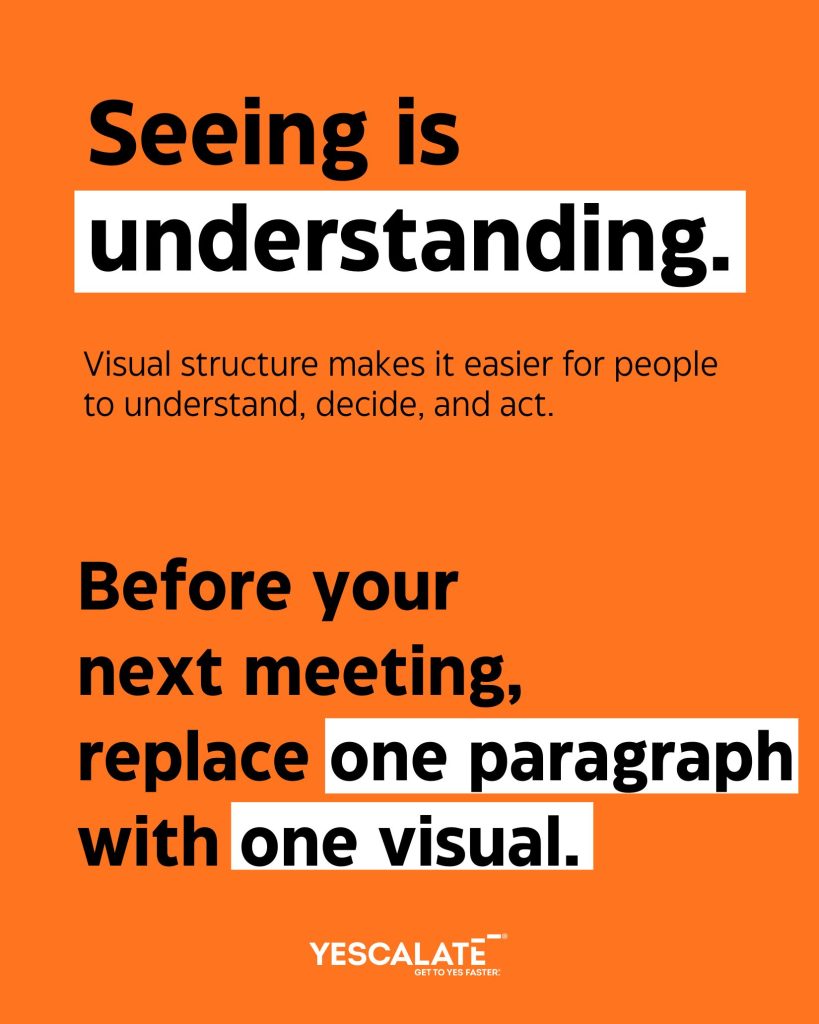
Visual structure reduces that cost. It doesn’t replace thinking; it makes thinking easier. If you can change the odds of an outcome, it’s not luck. Making your message visual improves the odds in sales situations because it reduces confusion and helps others see the path forward.
This YESENTIALS® module breaks visuals into three practical levels:
1D: Turn words into pictures
Use simple diagrams, maps, sketches, and models. A basic flow diagram can replace a long explanation. The goal is not art; it’s structure.
2D: Show change
Before/after visuals, timelines, and progress markers help people understand what is shifting and why it matters. The brain is tuned to notice difference and contrast, so this format clarifies outcomes quickly.
3D: Make it tangible
Sometimes the most effective visual is the thing itself: a product, a sample, a prop, or a story that creates a clear picture. Tangibility reduces ambiguity and increases confidence.
A practical application for this week: before your next email, slide deck, or meeting agenda, ask yourself, “What is the simplest way to show this?” If the message matters, it deserves structure.
Clarity isn’t about saying more. It’s about making it easier for others to understand, decide, and act.